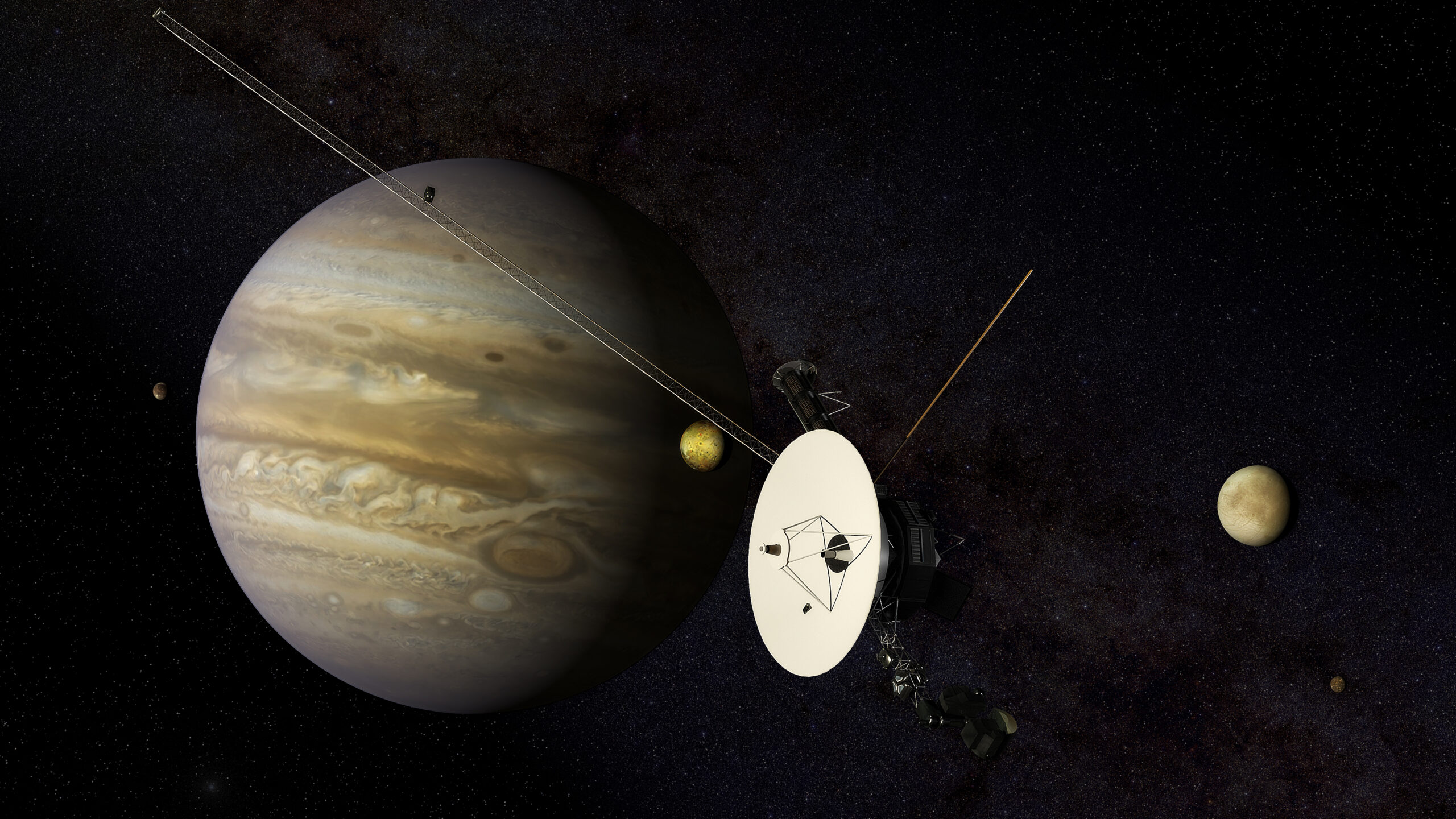
On July 9, 1979, NASA’s Voyager 2 spacecraft came within 404,003 miles (650,180 kilometers) of Jupiter. Launched in August 1977, the Voyager probes were originally planned to study Jupiter and Saturn. Voyager 1 arrived at Jupiter in March 1979, and Voyager 2 followed a few months later. Equipped with narrow- and wide-angle cameras, an interferometer, an ultraviolet spectrometer, a magnetometer, and more, Voyager 2 showed that the Great Red Spot was a storm system and revealed Jupiter’s thin ring system. Its investigations of the gas giant’s moons included confirming active volcanism on the moon Io and taking high-resolution images of Europa that suggested a ocean beneath its icy crust. Its success allowed Voyager 2 to extend its mission, becoming the only spacecraft to perform close-up explorations of Uranus and Neptune before continuing the journey into interstellar space.