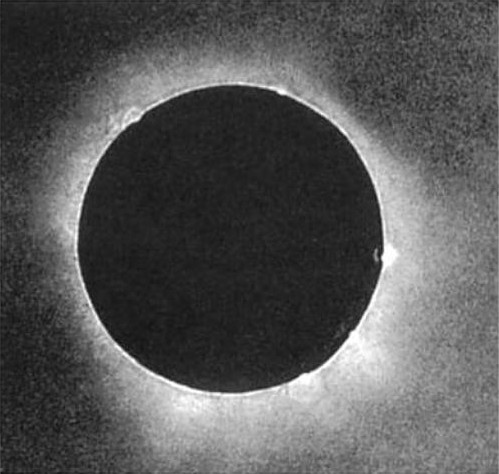
The total solar eclipse of July 28, 1851 is important for two reasons. First, English amateur astronomer and author George F. Chambers wrote that it was the first that spawned dedicated eclipse expeditions. The path of totality stretched from what is today western Canada to Ukraine. European astronomers, however, targeted Norway and Sweden. Bergen, Norway, and Gothenburg, Sweden, both major cities, experienced 3 minutes 17 seconds of totality. The second reason this event is notable is because during the 2 minutes 56 seconds the Moon obscured the Sun at the Royal Observatory in Königsberg, Prussia, a photographer named Johann Julius Berkowski took the first successful image of totality. He connected a camera that held a daguerreotype plate to a 2.4-inch refractor and made an 84-second exposure.