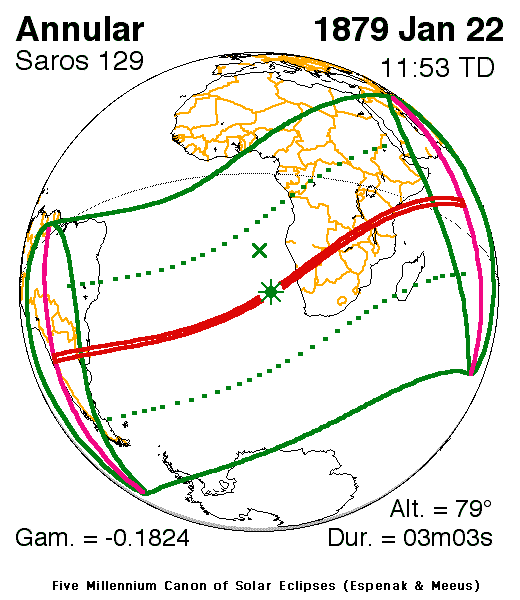
On Jan. 22, 1879, an annular solar eclipse passed over parts of South America and Africa. The same day, the second major battle of the Anglo-Zulu War was fought at the foot of a hill called Isandlwana, in present-day South Africa. In a shock to the empire, the colonial British army invasion force was soundly defeated by warriors from the Zulu Kingdom. Though the British had superior weaponry and were more experienced soldiers, the Zulus were good tacticians, surrounding their ranks and cutting off escape. They also triumphed through sheer numbers: That morning, the Zulus attacked about 1,500 redcoats with a force of 20,000-30,000 warriors. Nearly all the British soldiers were killed, as well as 2,000-3,000 Zulus. It was one of the first major defeats faced by the Victorian British Empire.
Around 2:30 in the afternoon, as the fighting was raging, the sky grew dark – and not just from the dust and smoke of battle. One combatant recounted: “The sun turned black in the middle of the battle; we could still see it over us, or we should have thought we had been fighting till evening. Then we got into the camp, and there was a great deal of smoke and firing. Afterwards the sun came out bright again.” The Zulu word for the battle translates to “the day of the dead moon.”