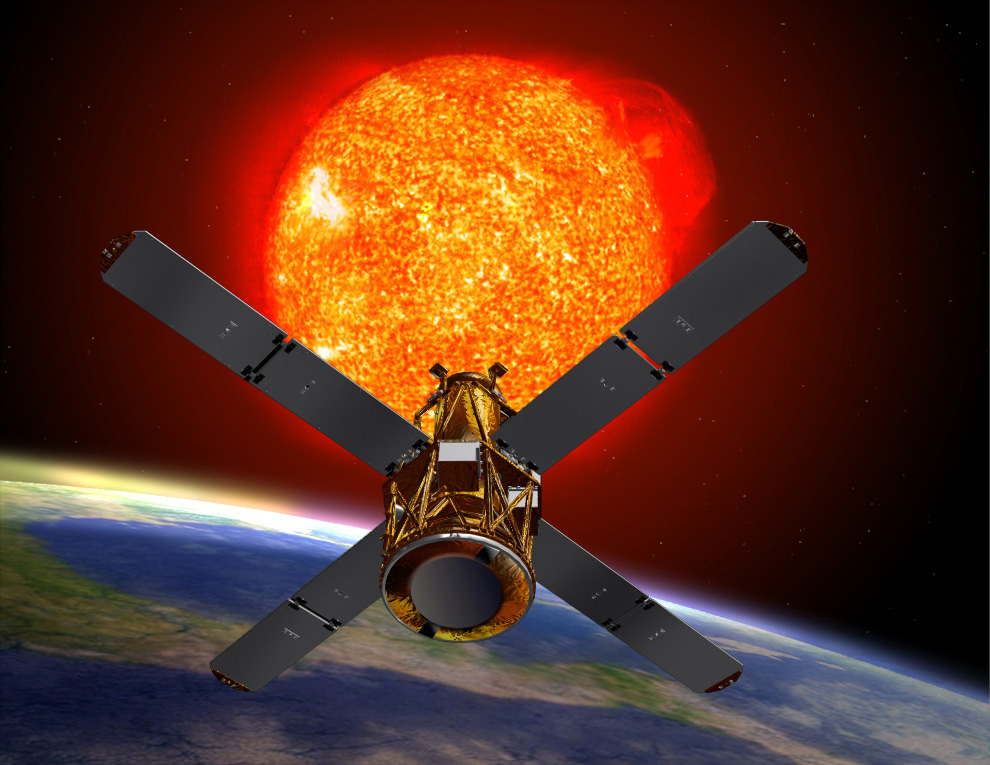
Commissioned with observing high-energy events, particularly solar flares, the High-Energy Solar Spectroscopic Imager (later renamed the Reuven Ramaty High-Energy Solar Spectroscopic Imager; RHESSI) launched Feb. 5, 2002. RHESSI conducted simultaneous observations in X-ray and gamma ray with its solitary instrument – an imaging spectrometer – and returned the first images of solar flares in those wavelengths.
RHESSI also sometimes worked in tandem with missions like NOAA’s GOES (Geostationary Operational Environmental Satellite) and solar observatory TRACE (Transition Region and Coronal Explorer). Throughout its 16-year life, the spacecraft observed more than 100,000 events, allowing scientists to create new models and refine existing understandings of solar flares and coronal mass ejections. It also helped improve measurements of the Sun’s shape.
RHESSI was part of NASA’s Small Explorer Program, focusing on frequent flights that were comparatively inexpensive and very focused. It was decommissioned in 2018, and in 2023 reentered Earth’s atmosphere over the Sahara Desert.