On Feb. 22, 1906, German astronomer Max Wolf made a discovery that adjusted astronomers’ view of the cosmos and provided proof for the century-old predictions of Joseph-Louis Lagrange. A pioneer in the use of a comparator to examine astrophotographs side-by-side, Wolf had discovered 18 new asteroids within his first two years of searching.
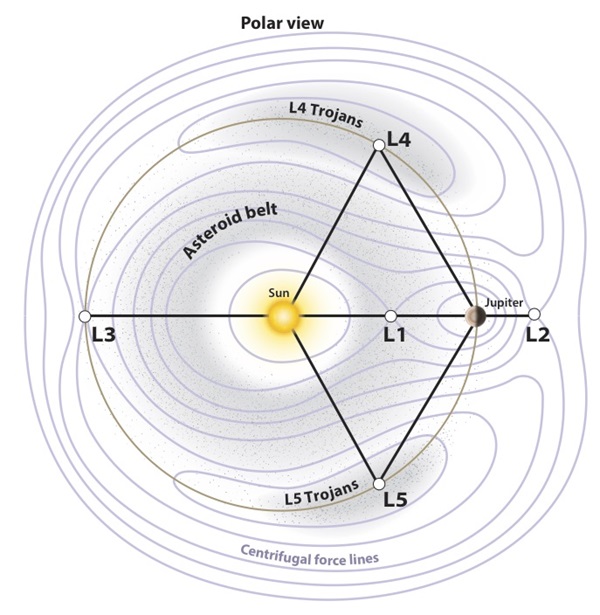
Wolf’s 1906 discovery was an asteroid that appeared to be linked to Jupiter’s orbit, remaining about 60 degrees ahead of it. The first Trojan asteroid to be found, it would later be named Achilles. Trojan asteroids reside at a planet’s L4 and L5 Lagrangian points, where the gravitational pull of the Sun and the planet creates stable spots for asteroids to assemble and move about 60 degrees ahead of or behind the planet. Since the discovery of Achilles, Trojan asteroids have been found at the Lagrangian points of Neptune, Mars, Earth, and Uranus, though Jupiter has the largest collection, with over 7,000 known and many more predicted.