From a young age, Arthur Eddington, who was born Dec. 28, 1882, in England, excelled in math and physics. After graduating from Trinity College, Cambridge, in 1905, he became the chief assistant to the astronomer royal the following year.
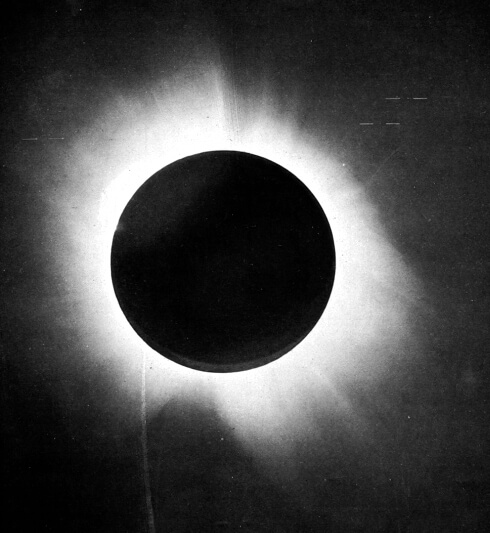
While famous for his 1919 eclipse expedition to verify Einstein’s General Theory of Relativity, Eddington also had a long list of other achievements: He researched the nature of stars extensively, becoming the first to model the interior of stars to show how gravity, gas, and radiation pressure maintain stability, and estimating their internal temperatures. He theorized that the fusion of hydrogen was a main source of a star’s energy long before it was widely understood, and established the Eddington limit – the natural extent of a star’s luminosity. He also was an early proponent of the expanding universe – although he did reject the concept of the Big Bang. Eddington died at age 61 in 1944.