
Key Takeaways:
- Following months of hindered radar observations, the Arecibo Observatory Planetary Radar came online from December 15-19, 2017, to observe asteroid 3200 Phaethon during its closest approach until 2093.
- Radar images, captured at 250 feet (75 meters) per pixel, revealed the asteroid to be spheroidal with a diameter of approximately 3.6 miles (6 km), exceeding its previously estimated 3 miles (4.8 km).
- Astronomers identified a depression stretching at least a few hundred meters near the asteroid's equator and a dark, spherical spot close to one of its poles.
- Phaethon is classified as a "potentially hazardous" asteroid due to its large size and proximity to Earth, representing the second largest object with this designation, and is monitored by NASA’s Planetary Defense Coordination Office.
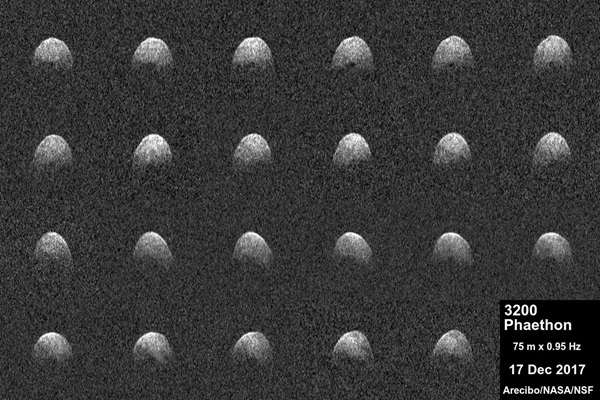
Following months of hindered radar observations caused by Hurricane Maria’s power outages, the Arecibo Observatory Planetary Radar came back online just in time to observe asteroid 3200 Phaethon as it neared Earth, from Dec. 15-19, 2017. At its closest, the asteroid was 6.4 million miles (10.3 million kilometers) away, the nearest it will be until 2093. The radar images taken during its fly-by, including the above series from Dec. 17, allowed astronomers to distinguish never-before-seen characteristics of the asteroid.
The images, captured at a resolution of 250 feet (75 meters) per pixel, revealed the asteroid is spheroidal in shape and has a larger body than previously thought. Researchers originally believed that the object had a diameter of about 3 miles (4.8 km), but the new snapshots showed it has a diameter of roughly 3.6 miles (6 km). The researchers also used Arecibo’s radar to spot a depression near 3200 Phaethon’s equator that stretches a few hundred meters at minimum, as well as a dark, spherical spot close to one of the asteroid’s poles.
Because of its large size and proximity to Earth, Phaethon is categorized as a “potentially hazardous” asteroid, being the second largest object with that designation, and is monitored by NASA’s Planetary Defense Coordination Office.