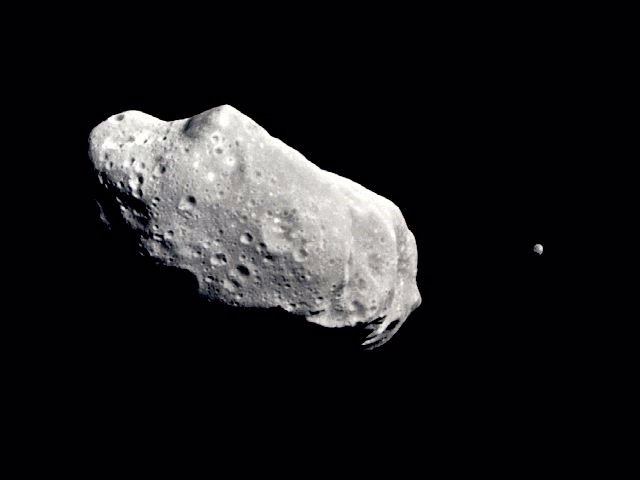
The space probe Galileo was launched in 1989 with the goal of studying Jupiter and its moons. On its way to the gas giant, it became the first spacecraft to do a flyby of an asteroid as it zoomed past 951 Gaspra on Oct. 29, 1991. Then, on Aug. 28, 1993, Galileo made its second such encounter as it cruised by 243 Ida, coming within in 1,500 miles (2,400 kilometers) of the main-belt asteroid. Though Galileo imaged both objects, an antenna failure limited the spacecraft’s data-transmission abilities. However, its imaging team was able to adapt by receiving only about three lines out of every 20 or so that made up a mosaic, essentially giving them a preview of possible areas for which they should retrieve more data. Five months later, Ann Harch and other members of the imaging team observed something in one of these lines that appeared to have the same surface brightness as Ida, but was staged off to its side. Receiving further information from Galileo’s transmission took about three weeks, but eventually confirmed the unexpected: Ida had a moon, Dactyl. Named for the beings that lived on Mount Ida in Greek mythology, it was the first known satellite of an asteroid.