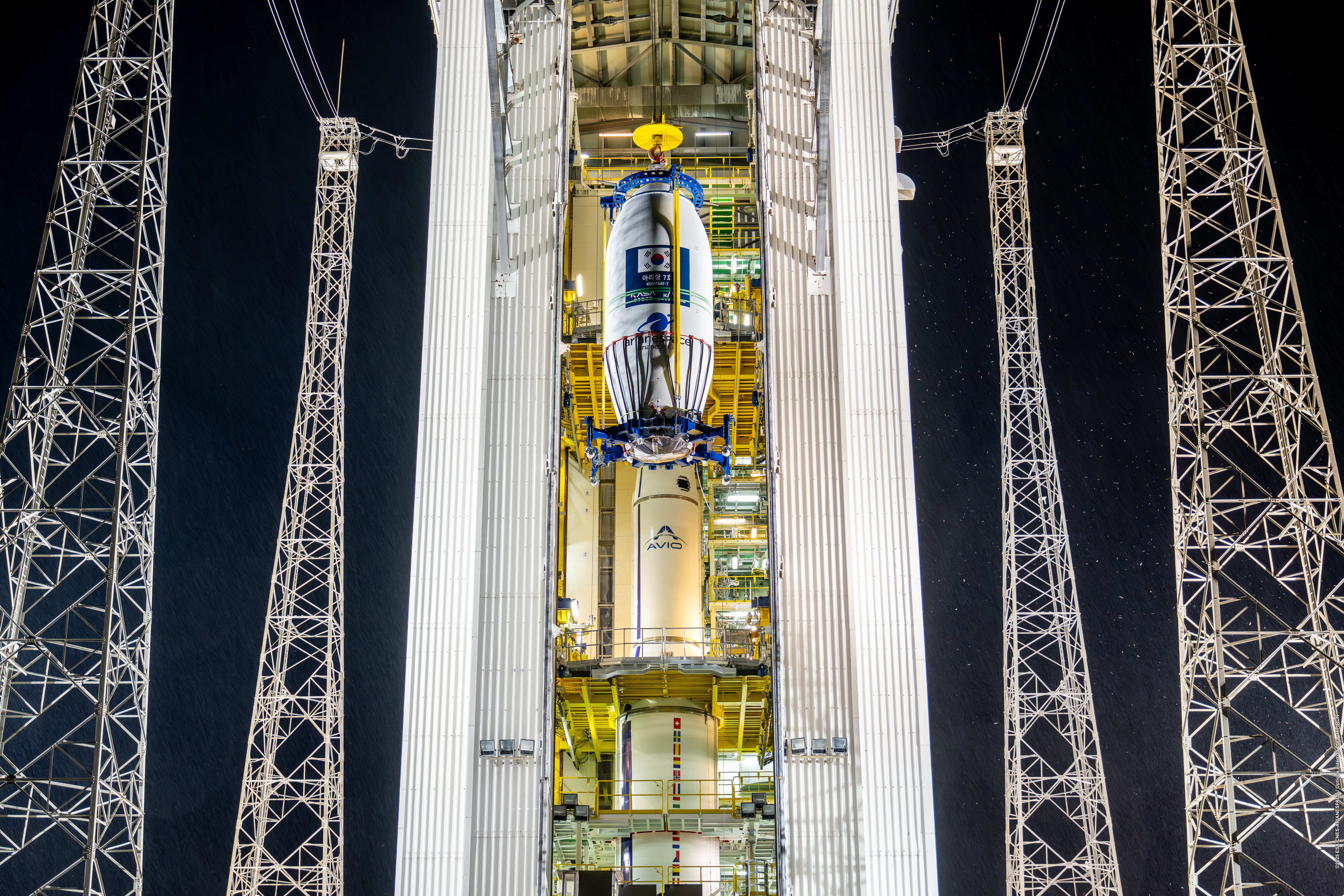
Mission Highlight: Vega C launches KOMPSAT-7 for South Korea
The mission highlight this week is the launch of the KOMPSAT-7 Earth observation satellite by Arianespace. The launch, flight VV28, is scheduled for Monday, Dec. 1, from Europe’s Spaceport in Kourou, French Guiana aboard a Vega C rocket at 12:21 p.m. EST.
The Vega C is a beefed-up version of the original Vega rocket, designed to fit larger satellites and carry heavier payloads — up to 2.3 tons to Sun-synchronous orbit. The vehicle also sports a larger fairing that doubles the available payload volume and an improved version of the Attitude & Vernier Upper Module (AVUM) upper stage, known as AVUM+, with larger propellant tanks. Capable of seven re-ignitions, AVUM+ enables complex mission profiles, including delivering up to three payloads to different orbits during a single flight.
Flight VV28 carries KOMPSAT-7, an ultra-high-resolution optical satellite developed by the Korea Aerospace Research Institute (KARI). Designed as the successor to KOMPSAT-3A, this 3,990-lb (1,810 kg) satellite features a high-precision optical camera and a significantly faster onboard computer than its predecessor, allowing it to capture and transmit large amounts of data in real-time. The satellite is also much more agile due to the inclusion of a control moment gyroscope (CMG) — a type of attitude control system that uses gimbals to angle a spinning rotor, inducing a torque that changes the craft’s orientation. The CMG allows KOMPSAT-7 to quickly point its lens at different targets. Once in orbit, the satellite will provide the South Korean government with detailed views of the Korean Peninsula. This marks Arianespace’s sixth launch of 2025.
Other missions this week
Tuesday, Dec. 2: SpaceX is scheduled to launch the Starlink Group 15-10 mission on a Falcon 9 Block 5 from Vandenberg SFB, California, at 12:28 a.m. EST.
Tuesday, Dec. 2: In a separate flight, SpaceX is set to launch the Starlink Group 6-95 mission on a Falcon 9 Block 5 from Cape Canaveral SFS, Florida, at 3:16 p.m. EST.
Thursday, Dec. 4: SpaceX is scheduled to launch the Starlink Group 11-25 mission on a Falcon 9 Block 5 from Vandenberg SFB, California, at 1:12 p.m. EST.
Thursday, Dec. 4: Rocket Lab is set to launch the “RAISE And Shine” mission on an Electron rocket from Launch Complex 1 on the Māhia Peninsula, New Zealand, at 10:00 p.m. EST. This dedicated mission for JAXA carries the RAISE-4 demonstration satellite.
Saturday, Dec. 6: Mitsubishi Heavy Industries (MHI) and JAXA are scheduled to launch the Michibiki 5 (QZS-5) navigation satellite on an H3-22S rocket from Tanegashima Space Center, Japan, at 9:30 p.m. EST.
Sunday, Dec. 7: SpaceX is scheduled to launch the Starlink Group 11-15 mission on a Falcon 9 Block 5 from Vandenberg SFB, California, at 11:13 a.m. EST.
Sunday, Dec. 7: SpaceX is also set to launch the Starlink Group 6-92 mission on a Falcon 9 Block 5 from Kennedy Space Center, Florida, at 4:40 p.m. EST.
Last week’s recap
The week of Nov. 24–Dec. 1 featured a diverse array of global launch providers, including major missions from China, Russia, and South Korea.
SpaceX maintained a high cadence with the Transporter 15 rideshare mission (Nov. 28) and Starlink Group 6-86 (early morning Dec. 1).
China successfully launched the crewed Shenzhou 22 lifeboat mission (Nov. 24) and the Shijian 28 satellite (Nov. 30).
Russia launched a military payload on an Angara 1.2 (Nov. 25) and the crewed Soyuz MS-28 to the ISS (Nov. 27).
South Korea launched the CAS500-3 satellite on KARI’s KSLV-2 rocket (Nov. 26).
Looking ahead
Next week sees continued activity into mid-December.
Rocket Lab targets a launch for the Space Test Program (STP-S30) on an Electron from Wallops Flight Facility on Dec. 8.
SpaceX is scheduled to launch the NROL-77 national security mission on a Falcon 9 from Cape Canaveral on Dec. 9, followed by another Starlink mission (Group 15-11) from Vandenberg on Dec. 10.