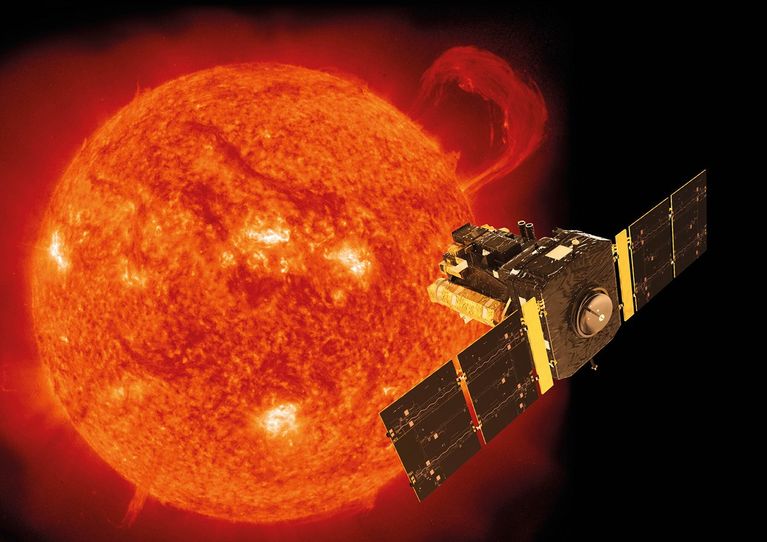
On April 27, 2001, the fifth anniversary of the commissioning of the Solar and Heliospheric Observatory (SOHO), the European Space Agency (ESA) announced that the spacecraft could look at the farside of the Sun. It was the first observatory to be able to do so: Prior to SOHO, scientists didn’t know when active regions and sunspots might be about to rotate into view and affect Earth. With this ability, SOHO enabled long-range forecasts of space weather, both to support technological systems on Earth and to more safely schedule crewed space missions.
The observatory uses two instruments to achieve this view. The Michelson Doppler Imager (MDI) uses a techniques called helioseismic holography to listen to the sound waves traveling through the Sun. The magnetic fields of sunspots causes their sound waves to arrive out of sync with those from sunspot-free regions, enabling scientists to “hear” where the sunspots are. The Solar Wind Anisotropies (SWAN) instrument maps around the Sun in ultraviolet light; sunspot regions illuminate the hydrogen cloud around the Sun more intensely than sunspot-free regions, creating what ESA calls “a lighthouse beam rotating in fog” and enabling scientists to “see” the sunspots.