
Key Takeaways:
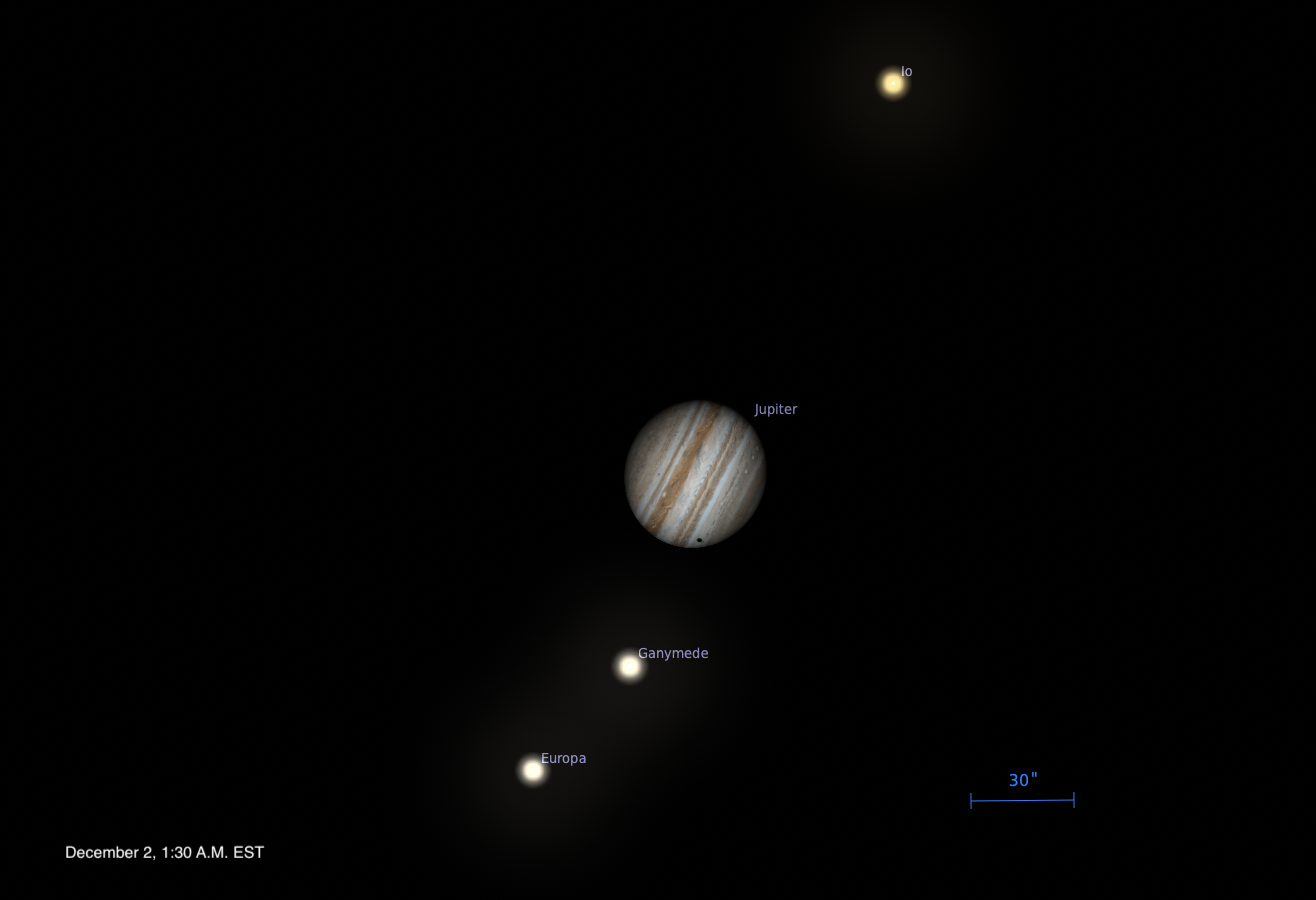
- The primary observational focus is Jupiter, featuring a transit of its moon Ganymede and its associated shadow.
- Prior to the transit, Ganymede and Europa will execute a close alignment and pass east of Jupiter, occurring just minutes before midnight EST.
- Ganymede's shadow is predicted to commence its transit across Jupiter's cloud tops at approximately 1:07 A.M. EST on December 2nd, concluding its egress around 4:18 A.M. EST.
- The moon Ganymede will begin its ingress onto Jupiter's disk at 4:44 A.M. EST, undertaking a transit projected to last more than three hours.
Looking for a sky event this week? Check out our full Sky This Week column.
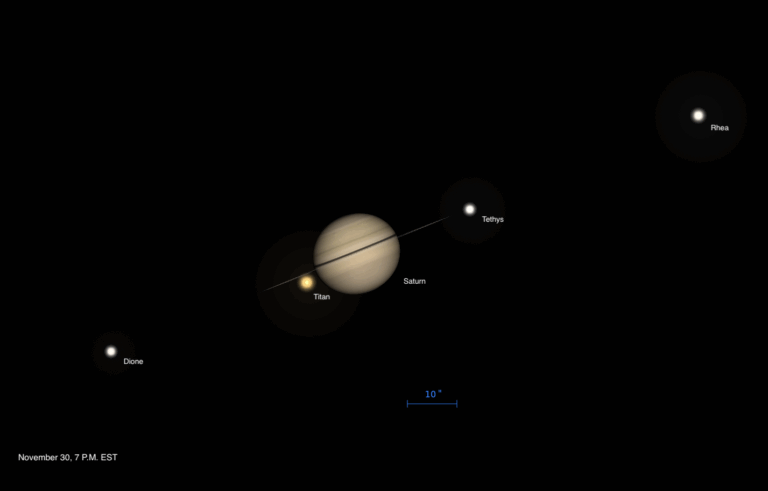
November 30: Watch Titan reappear
Jupiter is the object you’ll want to be watching this evening, as Ganymede prepares to transit along with its shadow. About an hour before that event starts, Ganymede and Europa line up as the two moons pass each other east of Jupiter.
The gas giant rises shortly before 8 P.M. local time. Once it’s visible above the horizon, train your telescope on it to check out the view. Io lies alone to the planet’s west; Callisto is far to the planet’s east. Early in the evening, Europa sits off Jupiter’s eastern limb and Ganymede is farther east. Watch as the two moons approach each other, finally passing just minutes before midnight EST, when Ganymede moves 12” due south of Europa. The two moons may appear to briefly blur into one for observers.
After this, Ganymede continues to close in, while Europa slips farther away to the east. Around 1:07 A.M. EST (now December 2nd for the Eastern and Central time zones), Ganymede’s shadow appears on Jupiter’s cloud tops to precede the moon across. It will take the large shadow some 10 minutes to fully appear. It continues across the face of Jupiter as Ganymede approaches; by 4:18 A.M. EST (now the 2nd across the U.S.), the shadow finally reaches the western limb and begins its egress. Ganymede finally moves onto the disk not long after, at 4:44 A.M. EST. The large moon will take more than three hours to cross Jupiter’s disk. Observers in the Eastern and Central time zones will see the Sun rise with Ganymede still making its way across; the moon finally ends its transit as the Sun is rising across the Mountain time zone.
Sunrise: 7:03 A.M.
Sunset: 4:35 P.M.
Moonrise: 2:02 P.M.
Moonset: 2:57 A.M.
Moon Phase: Waxing gibbous (88%)
*Times for sunrise, sunset, moonrise, and moonset are given in local time from 40° N 90° W. The Moon’s illumination is given at 10 P.M. local time from the same location.